What is Evie Platform?
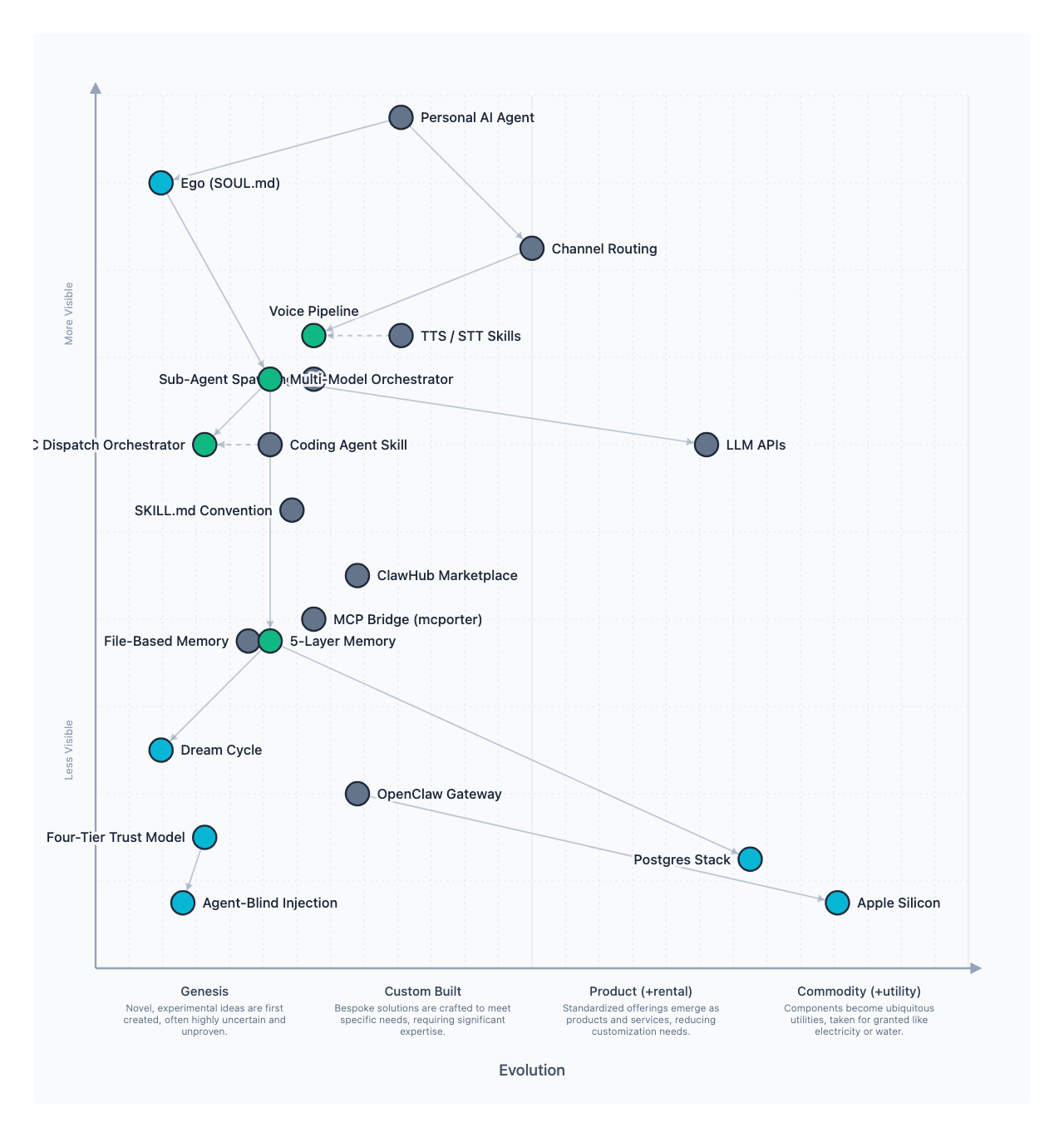
Evie Platform is an opinionated distribution of OpenClaw that turns the open-source agent runtime into a personal AI agent. OpenClaw is the kernel. Evie Platform is the full operating system: provisioning, memory, security, skills, and identity governance layered on top.
You provision a Mac, run a single bootstrap command, and walk away with a fully configured AI agent connected to your calendars, inboxes, tools, and messaging surfaces.
The Relationship to OpenClaw
OpenClaw provides the agent runtime: a gateway daemon, message routing, tool execution, and the SOUL.md personality system. It's the fastest-growing open-source project in history (343k+ GitHub stars), and Jensen Huang called it "the new computer" at GTC 2026.
Evie Platform builds on that foundation with three layers OpenClaw doesn't provide:
- Ego -- an executive layer that governs identity, behavioral policy, and sub-agent orchestration. SOUL.md gives an agent personality; Ego gives it judgment.
- 5-Layer Memory -- structured recall that replaces OpenClaw's flat file memory with episodic, identity, topical, procedural, and artifact layers, all built on an activity log foundation.
- Trust and Security -- progressive autonomy, agent-blind credential injection, and a four-tier trust model that treats security as a graduated dial, not a binary switch.
Think of it this way: OpenClaw gives you the engine. Evie Platform gives you the car.
Why Evie Platform?
Setting up an OpenClaw agent today requires tribal knowledge. Which Homebrew packages to install, how to configure SSH, where credentials live, how to wire up integrations, how to get Supabase running with the right extensions -- none of it is written down in one place. Every new agent deployment means rediscovering the same steps.
Evie Platform captures all of that into repeatable Ansible playbooks. One command provisions a bare macOS machine into a working agent host. A second, optional layer lets you personalize the agent with your own dotfiles, skills, and workspace configuration. The result is a setup that's reproducible, shareable, and takes minutes instead of hours.
What You Get
A dedicated Mac running macOS Tahoe serves as the agent's home. It's hardened with key-only SSH authentication and connected to your tailnet for secure remote access.
OpenClaw runs as the agent runtime, installed globally with the gateway running as a launch agent that survives reboots. The agent wakes up, reads its personality from SOUL.md, and starts working.
Supabase provides the data backbone. Every Evie Platform agent gets a local Postgres instance with pgvector, ParadeDB (BM25), and pg_trgm extensions, powering the five-layer memory system, activity log, and hybrid search (vector similarity + full-text + fuzzy matching). It runs in Docker via Colima, managed by Compose.
Ansible playbooks handle the entire setup -- from Homebrew installation to SSH hardening to service configuration. Run them again anytime to converge. They're idempotent by design.
Who It's For
Consultancies and teams that want to give each member a personal AI agent will find Evie Platform removes the setup friction entirely. Define a shared config repo with your organization's defaults, and new agents inherit the same tooling, skills, and conventions.
Individual practitioners exploring AI copilots beyond chat windows get a reproducible setup they can rebuild from scratch. If your Mac dies, you're one bootstrap command away from being back online.
Design Principles
Turnkey by default. One command takes you from bare macOS to a working agent. You shouldn't need to read a wiki to get started.
Idempotent always. Run the playbooks again anytime -- after an update, after a config change, after you break something. They converge to the desired state without side effects.
Opinionated but extensible. Evie Platform ships sensible defaults (Tailscale for tunneling, Supabase for data, 1Password for secrets) but every choice can be overridden through the config repo layer.
Local-first sovereignty. Everything runs on your hardware. No data leaves the box unless the agent explicitly sends it. You own the full stack.
No magic, ever. Every step is documented. Every file has a purpose you can inspect. Nothing is hidden behind abstractions you can't read.